

Deconstructing SuperVOOC
How OPPO’s SuperVOOC Redefines Speed, Safety, and Battery Life.

Do you remember those micro-USB 3.0 cables? I can’t quite explain the look, but it looked like a micro-USB was glued to a data cable. Honestly, it was a really ugly cable.
So when the Samsung Galaxy S5 first dropped, I had one, and I felt like I was living in the future (aside from that awful charger flap). It came with a micro-USB 3.0 cable, and I didn’t think much about it until one day I lost it.
I was a little annoyed about it, but I ultimately decided to try a regular micro-USB 2.0 cable, and suddenly my phone took forever to charge compared to the 3.0.
And that’s when it hit me: charging speed seriously changes how you use your phone. It sounds dramatic, but listen — once you’ve tasted fast charging, going back is awful. Have you ever tried using those original 5W iPhone bricks lately? Try it and see what I mean. It works, technically, but you’re going to suffer.
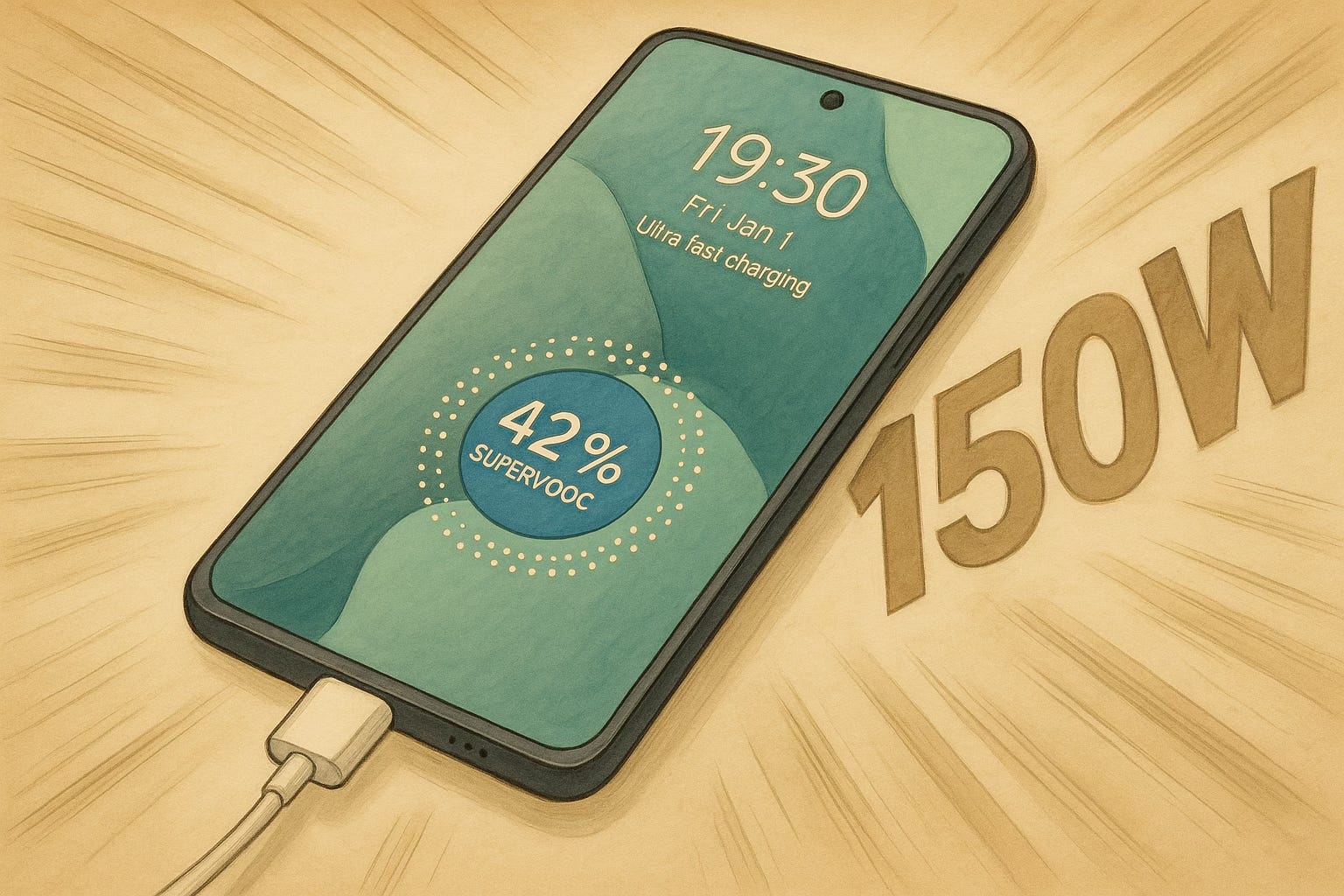
That brings me to SuperVOOC: OPPO’s extremely fast charging system. In this post, I want to break down how it works, why it is so fast, what makes it safe, and whether it comes with any trade-offs.
What is SuperVOOC?
SuperVOOC is OPPO’s ultra-fast wired charging technology. It is one of the fastest consumer charging systems in the world. The most extreme version, the 240W SuperVOOC, can fill a 4,500 mAh battery from 0-100% in ~9 minutes.
With that said, SuperVOOC is more than just wattage, it is a completely different architecture. It uses dual-cell batteries, specialized charge pumps, thicker cables, and a high-power charging brick to safely push more current than standard USB-C Power Delivery allows.
Battery Basics
Before we start talking about why SuperVOOC is so fast, I think it will help to understand what is actually happening inside a lithium-ion battery. I am not much of a battery engineer so I will break it down as simple as I can.
A “current” is just the flow of electrical charge through a wire. It is measured in amps (A). More amps = more electrons moving = faster charging. If electrons were water, amps would be the flow rate of the water.
Now inside the battery, electrons don’t move alone. The real work is done by lithium ions-atoms of lithium that lost an electron and carry a positive charge. These ions move between two layers inside the battery:
Anode: Where lithium stores during charging.
Cathode: Where lithium stores during discharging.
Think of anodes and cathodes as parking garages: when you plug in your phone, the charger pushes electrons toward the anode. The change in electrical pressure (voltage) pulls lithium ions along, causing them to migrate from the cathode into the anode. The more ions that fit into the anode’s structure, the “fuller” your battery is.
But here is the catch: as the anode fills up, it gets harder to pack more ions in. If you push ions in too aggressively (too much current), the lithium can start plating on the anode’s surface instead of slotting neatly inside. That is baaaaadddd for battery health.
This brings us to the three numbers you see on chargers:
Voltage (V): Electrical pressure pushing ions across.
Current (A): How much charge is flowing.
Power/Watts (W): Volts x Amps; total charging strength.
A simple analogy: we have a bucket that can hold 30 liters of water. The 30 liter bucket is the battery capacity (mAh). We have a faucet attached to the bucket to drain the water out of. The pressure at which the water comes out of the bucket is the voltage (v/volts) and how much water is actually coming out each second from the bucket and out of the faucet is the current (a/amps).
But let’s be real here: you might still only really understand it in real-world info:
36W is the max the iPhone 17 Pro Max can take.
70W is the max the M4 MacBook Air can take.
240W is the max a SuperVOOC battery can take. Yeah, that is insane…
315W is the max the Xbox Series X can take.
Keep in mind though, these numbers are what the device is willing to draw, not just what the brick can provide. You can plug an iPhone into a 140 W MacBook charger; it will still only sip ~30 W.
These basics matter because the limits of lithium-ion chemistry (heat, plating, and current) are exactly the challenges SuperVOOC has to solve.
How “Normal” Charging Works
Before SuperVOOC and other ultra-fast systems came along, most phone charging followed a standard pattern. A charger would push somewhere between 6 W and 15 W into your phone with 5V being the modest current (1-3A). They charged this slow mainly because lithium-ion batteries have some very real physical limitations to them.
To understand why fast charging is hard, you need to know two concepts: C-rate and CC/CV charging curve.
C-Rate
C-rate describes how fast a battery is being charged relative to its capacity. The “C” stands for capacity.
1C means a full charge in one hour.
A 4,500 mAh battery charged at 1C pulls about 4.5A.
So if a charger pushes 9A into that same battery, that is roughly 2C charging.
Phones traditionally stay well below 1C to avoid stress on the battery. As you push beyond that, the chemistry starts complaining.
Why Lithium Batteries Don’t Like High Current
All our problems would be solved here if we just said, “Hey, just use your laptop charger!” Lithium-ion cells have real physical limits:
Heat Buildup: More current = more heat = faster aging.
Lithium Plating: If ions are pushed too aggressively into the anode, they deposit on the surface instead of fitting inside, permanently reducing capacity.
Gas Formation and Swelling: Internal side reactions can create pressure inside the cell. You’ll end up like an iPod nano.
This is why phones don’t just crank current higher until the battery bursts into flames.
By the way, people have brought up this concern about using a laptop charger on your phone. I promise, modern devices aren’t stupid: you can safely use your laptop charger on your phone.
The CC/CV Curve
Every lithium battery, from a phone to an EV, uses a charging method called constant current/constant voltage.
CC Phase (fast part): The charger provides a steady current while the battery voltage rises. This is why your phone charges quickly from 0-50%.
CV Phase (slow part): Once the battery reaches its target voltage, the charger holds the voltage steady and gradually tapers the current. That is why 80-100% always feels slower. The phone is protecting the anode from overstuffing.
Phone manufacturers stay within these boundaries because pushing beyond them risks heat, plating, and long-term wear. SuperVOOC aims to break through these engineering walls by redesigning the whole charging system so that the battery chemistry can stay happy even at these insane power levels.
Architectural Design
As I mentioned, SuperVOOC is more than just “more power”. The real advantages of this technology come from how the phone’s internal circuitry and battery pack are designed. This is where OPPO differs radically from standards like USB-C PD.
Dual-Cell Battery Architecture
This is important since it is pretty much the heart of SuperVOOC. Instead of just using, for example, one large 4,500 mAh cell, OPPO uses two smaller cells inside the phone.
These cells are usually arranged in series, which doubles the battery pack voltage. A bunch of mumbo jumbo, but if you remember what voltage was (hint: electrical pressure pushing ions across), it means that SuperVOOC can use higher voltage while using a lower current for the same power. The fact that SuperVOOC uses a lower current means that there is less heat and stress on each cell. Each individual cell “sees” only half of the total current flowing into the battery pack. The pack can absorb power much faster than a single large cell.
This architectural decision is what allows SuperVOOC to safely move into the 150-240W range without cooking the phone.
Multi-Stage Conversion and Parallel Charge Pumps
Okay, now we are getting into a more technical topic. The speed doesn’t just come from the wattage alone. It also comes from how OPPO manages that wattage inside the device.
OPPO uses a pretty clever multi-stage charging system. The 240W SuperVOOC charger sends high-power electricity through the USB-C cable. About 20V.
Inside the phone, this power goes through three charge pump chips working in parallel. If you don’t know, a charge pump is basically a tiny power converter whose job is to turn high-voltage/low-current power into low-voltage/higher-current power. More current means that the battery fills faster.
After conversion, the phone ends up with about 10V and roughly 24A, which matches the special dual-cell battery inside the device.
By using three chips instead of one, the phone spreads the 240W load so each chip only handles around 80W. This helps keep temperatures under control, improves efficiency, and safely allows the ultra-fast charging speeds SuperVOOC is known for.
Heat Management
Part of the architecture is how to handle heat. Usually, fast charging comes with heat. Charging standards like USB PD, Qualcomm Quick Charge, and PPS raise the voltage and require the phone’s internal regulators to step it down.
This conversion is not free. Some energy gets lost as heat, and at high power levels, that heat ends up building up inside of the phone, right next to all of the sensitive components and tightly packed batteries.
SuperVOOC found a solution to this. Instead of making the phone do all of the heavy lifting, it pushes most of the hard work into the charging brick. The brick does the big voltage conversion, and the phone only performs a simpler, final adjustment before sending power to the battery.
This means that the parts that get the hottest, the high-power converters, stay outside of the phone, keeping the phone itself cooler and safer while still charging extremely fast (up to 240W fast).
Cables and Connectors
Outside of all the convertors, pumps, and battery cells, the cables play as much of a role in the whole architecture. SuperVOOC relies on proprietary, high-gauge USB-C cables.
Truthfully, I don’t really like this part (or the charging brick part). I feel like I am a little too old at this point to deal with proprietary connections. I can’t remember a time when I had a separate cable for my phone, personal computer, iPad, work computer, AirPods, etc. It feels so ancient. But I guess to be able to hit these triple-digit numbers SuperVOOC can achieve, you need the right cables.
SuperVOOC cables
Contain thicker copper wires
Have lower resistance
Contain special ID chips for authentication
Are rated for 6A, 8A, and even 12A
Are designed to avoid voltage drop and overheating
Contain sensors and safeguards built into both ends
Standard USB-C PD Cables:
Are mostly limited to 3A with some high power PD cables containing e-markers that go up to 5A
Not designed for sustained double-digit amperage
Without OPPO’s cable, the system refuses to deliver high power. This architecture forms a closed ecosystem where all components have to participate safely.
In summary, SuperVOOC’s system is built specifically for phones, right. It has to use a dual-cell battery to absorb power with less heat. It needs to have multi-stage conversion steps to split 240W across several charge pumps. It needs to off-board heat on the brick so that the phone stays cool, and use high-current cables to deliver that power safely.
Safety
Okay here is the thing. If you are going to pack 100+ watts into a phone, you better have some safety features. Phones are small devices. Have you ever held a hot phone in your hand? You start to get a little concerned. It burns a bit, too. Assuming you have an iPhone, it probably takes max 20W. Imagine the heat, 1.5-2.5x that.
OPPO has a 5-layer protective system where they included protections such as preventing power surges, verifications on the cable/port, checking incoming voltage/current and throttle if over the limit, ensuring the battery is not overcharged or overcorrected, and a last resort safety cutoff in extreme conditions.
Let’s get into the details:
Protective Circuit on the Adapter: The charging adapter itself has a protective circuit that removes “hidden dangers from the root even if internal circuit is broken”. This tackles surge/adapter faults and prevents a faulty adapter from delivering unsafe current/voltage.
Intelligent Chip that Detects Voltage/Current: There is a chip that detects whether the voltage/current are safe for “flash charge” before starting or continuing.
Electrical Switch on the Connector: On the connector, there is a switch that acts as second line of defense against fluctuations of voltage/current. This is kind of like how Apple could tell whether you were using an authentic cable for the iPhone. Remember those annoying popups?
Advanced Protection on the Cellphone End: Like many phones, SuperVOOC phones come with protections. For example, monitoring internal parameters like battery temperature, voltage, current, etc.
Voltage-Fusing Protection: This is a fuse that guards against deviations from normal limits. If current/voltage go beyond safe limits, the fuse can blow. It is a last resort safety cutoff.
Safety is OPPO’s biggest priority with something like this. I am quite positive it doesn’t want their phones exploding on planes or in peoples pockets. Their system monitors not only current/voltage but also path impedance and temperature across the adapter, cable, device, and battery. For their more advanced versions, they have added things like battery safety detection chips, AI algorithms to detect external damage, and composite current collectors in battery to improve short-circuit resistance.
A lot of cool technology for the safety end, and you know what? I haven’t seen anything on the news about OPPO phones exploding (heh, Samsung). It might be too soon (or is it?) to see swollen batteries form though.
Battery Longevity
Extreme temperatures kill your battery. Faster charging = more heat, usually. OPPO has addressed this feature with a new feature called Battery Health Engine (BHE). BHE is a combination of software algorithms and battery chemistry tweaks that are designed to keep degradation under control.
Smart Battery Health Algorithm
This is the software side of BHE. It adjusts charging current in real time based on the condition of the battery and the temperature.
The algorithm is important because of that lithium plating issue mentioned earlier. Plating occurs when metallic lithium deposits onto the anode instead of sliding into its graphite layers (this is called intercalating). As mentioned, lithium plating means a permanent loss of capacity and a safety risk. Fun.
Plating is triggered by high current, low temperatures, high state of charge, and aggressive charging profiles. OPPO’s algorithm monitors a lot of this, and modulates charging to avoid the condition that cause plating. The algorithm gives you fast charging when the battery can handle it, and gentler charging when it cannot.
Battery Healing Technology
Oh yeah, the chemistry side of things.
This part is going to sound too good to be true, but the concept behind it is scientifically legit (as if I am qualified to say).
I didn’t really name the subheading. In fact, OPPO themselves call it Battery Healing Technology. It refers to a customized electrolyte additive package that helps maintain and repair the Solid Electrolyte Interphase (SEI).
A lot of words here. Let’s unpack it.
What is the SEI? The SEI is a thin protective layer on the anode. It forms naturally during the first few charge cycles. Its main role is to prevent the electrolyte from breaking down. Why? Because, having a healthy SEI means better capacity retention and stability.
OPPO is using additives that promote stable SEI formation and allow the SEI to reconstruct during cycling, filling little micro-cracks and helping the layer remain uniform. It is not really “healing” in the sci-fi sense like Jason Vorhees in Jason X; in fact, this is a known technique in battery chemistry. OPPO is just one of the first to loudly market it in consumer phones.
OPPO claims its batteries can sustain 80% of their original capacity even after 1,600 full charge cycles in lab tests. The typical industry standard is ~800 cycles for 80% capacity for reference.
But Physics Still Exist Right?
Yes, physics still exists. There is no breaking Newton’s Law of Cooling here. When a battery charges or discharges, it will generate heat due to electrical resistance in the internal materials or energy losses at the electrodes or electrolyte.
SuperVOOC by design reduces some heat generation. In reality though, the phone will get hot in real world use. I mean you are transferring 150W-240W of power to a small device at a pretty fast rate.
And yes, dumping huge amounts of current into a lithium-ion cell can shorten its lifespan if you do it carelessly. High current stresses the anode, encourages lithium plating, and accelerates degradation.
So the question is:
How do you push extreme power into a battery without causing extreme damage?
This is where OPPO’s thermal management, multi-stage regulation, battery chemistry tweaks, and real time charging algorithms come in. All of these systems work together to keep physics on its side.
And What About Wireless Charging?
Wireless charging is cool. And it would behoove you to know that AirVOOC does exist. But it isn’t 240W. Far from it. More like 40-50W. The reason that is, is because of heat. Lots of heat.
Wireless charging, especially pre-MagSafe/Qi2, was honestly very wasteful. It worked, don’t get me wrong, but so much energy you put in turned into heat instead of battery charge.
The problem lies with…. physics.
Wireless charging uses electromagnetic induction. A coil in the charging pad creates an oscillating magnetic field. Then there is a col in the phone that kind of catches that field and converts it back into electrical energy. It sounds pretty neat, but in practice, the coils aren’t ever perfectly aligned. On top of that:
The magnetic field spreads out in 3D instead of going straight into the phone
Some flux misses the receiving coil entirely
Eddy currents and coil resistance waste energy as heat
The air gap between coils is terrible for magnetic coupling, especially with phone cases adding onto that gap
All of this adds up to energy losses, and those losses show up as heat in both the phone and the pad.
Even MagSafe/Qi2 still isn’t perfect with their magnetic alignment. It improves coupling a lot, but it is still nowhere near the efficiency of a wired connection. Shoot, my 15W MagSafe can already make my iPhone warm. I cannot imagine what a 100W+ wireless charger would do.
Which Phones Use SuperVOOC?
SuperVOOC is OPPO’s fast charging brand, but not every SuperVOOC phone supports the top tier (240W).
Here are some examples:
The realme GT NEO 5 (China) supports 240W SuperVOOC charging.
The realme GT 3 also supports 240W SuperVOOC.
Some OPPO/OnePlus devices more modest SuperVOOC speeds. For example, the new OnePlus 15 supports 100W wired and 50W wireless.
As it stands, OPPO/realme/OnePlus phones support SuperVOOC. These three are owned by the same parent company, BBK Electronics, so it makes sense.
Why Aren’t Other Tech Companies Following?
No big tech company has publicly said, ‘We’re not using SuperVOOC because…’, but I think it comes down to priorities.
Universality > Proprietary Speed
For most global brands, the appeal of USB-C Power Delivery (PD) is simple: it is universal, predictable, safe, and works across so many devices. I, like many other people, aren’t in the business of carrying five different chargers. Heck, I hate the fact that I have to carry a special one just for my Apple Watch (not even kidding, I leave it at home when going on vacation sometimes just because of this). Remember SuperVOOC relies on a proprietary system. This gets awkward in a world where regulators (in the EU) are pushing hard for standardization.
Safety + Brand Risk
Also, charging batteries fast is one thing. Charging them recklessly fast is another. After incidents like the Samsung’s Galaxy Note 7 crisis, large global brands are extremely careful about having incidents like this. Big brands are most likely wary of adopting a system where one weak link in an ecosystem like SuperVOOC could cause a failure.
Design
It is also important to note designers have to fight with real estate on phones. SuperVOOC phone designs usually rely on:
Dual-cell battery configs
Larger boards for charge pumps
Beefier thermal management
Thicker, reinforced cables
Additional temperature sensors
This is easier to pull off in markets where phones are thicker, larger, and more spec driven. But in the Western world, priorities are at:
Ultra-thin designs
Minimal internal complexity
Tightly packed camera modules
Foldable phones
Market Demands
All who is this for? In China and India, charging speed is a major selling point. There is an arms race: 65W → 80W → 100W → 150W → 240W. Having a full charge in under 10 minutes is a headline out there.
But I live in the U.S. People don’t care too much about charging speed like that. It took a long time for the iPhone to even get fast charging. The average user out here charges overnight, during a commute, at work, and even use dinky wireless chargers.
There is Competition Though
SuperVOOC is not the only ultra fast charging system out there today. OPPO may lead in peak charging speeds (I think), several manufacturers have their own high-wattage systems that close the gap.
Xiaomi Hypercharge
HyperCharge is one of OPPO’s closest competitors. Deviceds like the Xiaomi 11T Pro supports 120W wired charging, and in ideal conditions, its 5,000 mAh battery can hit 100% in roughly 17 minutes. Xiaomi has also shown off 200W+ prototype charging, though it hasn’t been widely commercialized yet.
Samsung
Samsung’s fast charging approach is much more conservative than the other two.
Their “Adaptive Fast Charge” and “Super Fast Charging” standards are essentially USB PD PPS profiles capped at:
25W for most Galaxy models
45W for Ultra devices
Huawei SuperCharge
Huawei’s SuperCharge system is another strong contender.
Depending on the model, Huawei phones offer:
66W
88W
100W wired charging
Many of Huawei’s 100W-supported devices can reach a full charge in 20–30 minutes, putting them firmly in the “fast but not insane” category.
Conclusion
SuperVOOC is a big step in charging technology. With OPPO redesigning the charging architecture, using dual batteries, high currents, smart charge pumps, and safeguards, they have enabled charging speeds that are blazing fast.
Having said that, this approach comes with challenges like ensuring safety, preserving battery health, and maintaining compatibility. Not every manufacturer seems to be convinced to make the trade-offs on their devices, at least in the West, which is why Apple, Samsung, and others have stayed with more “safe” charging speeds for now.
At the end of the day, whether we will see every phone adopt super fast charging speeds is unclear. It could remain a differentiator for certain brands and models, but I hope the innovations from SuperVOOC do have some influence on the industry. I personally would love to see USB PD evolve to support faster charging speeds in the future as batteries become bigger our devices.